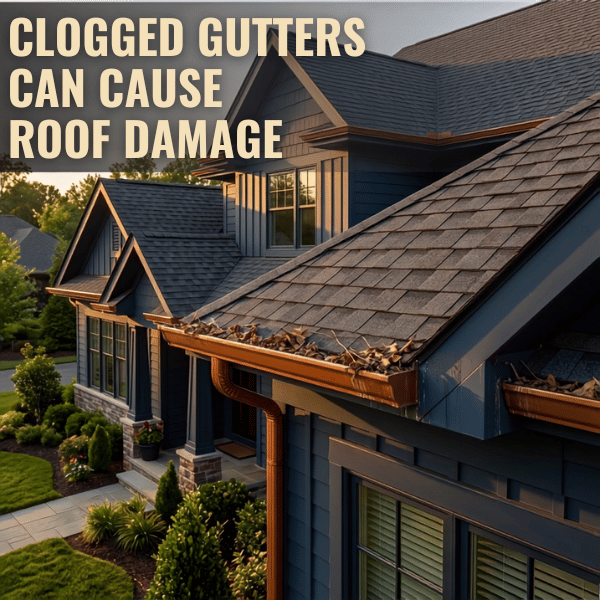
Homeowners often overlook how quickly roof damage by clogged gutters occurs during heavy rainstorms. Water backs up along the eave line when pine needles and leaves block flow, accelerating roof damage by clogged gutters across the lower roof system.
When drainage stops, standing water pools inside the gutter trough. The water level rises above the metal apron edge. This water weight creates continuous downward force against your fascia boards. According to technical research from GAF, blocked gutters force trapped moisture under asphalt shingles and into wood structures. The standing water breaches vulnerable roof entry points.
How Hydrostatic Pressure Drives Roof Damage by Clogged Gutters
Hydrostatic pressure measures the force exerted by standing fluids at rest. A full gutter trough holds immense fluid weight against the eave. Water seeks the path of least resistance under this pressure.
The fluid level eventually rises higher than the drip edge flange. Standing water presses directly against the lower roof edge. This fluid force pushes past the primary shingle seal.
As asphalt shingles sit submerged, water finds tiny gaps between overlapping courses. Hydrostatic force drives water upward behind the starter strip. The fluid breaches the standard water-resistive barrier.
Once liquid penetrates the underlayment, it directly contacts the structural plywood decking. Wood absorbs this moisture instantly. The wood fibers swell and weaken.
Continuous hydrostatic pressure transforms minor drainage delays into structural failure. Over time, heavy water pressure degrades fascia attachment points. Fasteners loosen from saturated framing lumber.
Homeowners can avoid these failures with a complete residential roof replacement designed to handle severe water loads. Proper drainage architecture shields structural wood from continuous fluid pressure.
Capillary Action and Eave Rot From Roof Damage by Clogged Gutters
Capillary action describes how liquids flow through narrow spaces without external forces. Microscopic gaps between roof components act as thin tubes. Water travels upward against gravity through these tiny channels.
When gutters fill with organic debris, water stays trapped against the shingle edge. Surface tension draws this liquid upward between overlapping shingle sheets. The water migrates past the adhesive sealing strip.
This upward migration brings moisture directly beneath the shingle substrate. The liquid reaches the unsealed roof deck edge. Plywood edges lack protective factory coatings.
Exposed wood edges absorb trapped water like a sponge. This persistent moisture triggers wood-decay fungi growth. Fungi break down cellulose fibers within structural framing.
The structural wood softens as decay spreads along the eave line. Rotted decking loses nail-holding capacity during strong wind events. Fasteners pull free from softened wood framing.
Installing modern gutters & gutter guards eliminates stagnant water traps at the eave. Eliminating standing liquid stops capillary action before moisture migrates upward.
Virginia Climate Factors Elevating Roof Damage by Clogged Gutters
Virginia experiences dynamic seasonal shifts that stress roof drainage systems. Heavy oak canopy drops dense leaf loads every autumn. Spring rains deliver sudden, high-volume precipitation across local watersheds.
In winter, temperature fluctuations create severe freeze-thaw cycles. Trapped water in blocked gutters freezes solid overnight. Thermal expansion expands ice volume by roughly nine percent.
This expanding ice pushes outward against aluminum gutter walls. Ice forces the gutter rim away from the fascia board. The heavy ice mass bends gutter support hangers.
Thawing ice forms dangerous ice dams along cold eave edges. Meltwater pools behind the ice ridge. Pooled meltwater backs up under shingle courses.
During summer, extreme heat creates intense UV degradation on damp wood. Wet plywood decks under hot shingles bake rapidly. This combination accelerates wood rot and delamination.
Homeowners in Stafford County often face heavy pine needle debris that packs gutter troughs tightly. Pine needles form dense mats that hold moisture against wood trim for weeks.
Similarly, properties in Spotsylvania County encounter heavy spring pollen and maple seeds. These fine materials form thick sludge that blocks downspout openings completely.
Structural Decking and Fascia Failure Mechanisms
Roof systems function as integrated structural assemblies. A failure at the drainage boundary compromises the entire system. Water backup damages multiple components simultaneously.
First, the fascia board absorbs trapped water from the rear gutter wall. Paint cracks and peels from the timber surface. Fungi invade the raw wood fibers beneath the paint layer.
Second, rafter tails absorb moisture through end-grain exposure. End-grain wood draws liquid rapidly into deep structural framing. Replacing rotted rafter ends requires extensive structural framing repairs.
Third, the lower soffit panels collect backing water. Excess moisture creates dark water stains on soffit vents. Trapped humidity inside soffits invites mold growth across interior roof cavities.
Fourth, saturated insulation loses thermal resistance capabilities. Wet attic insulation increases home heating and cooling costs. Damp conditions inside the attic promote airborne mold spores.
Homeowners can review options on our why us page to see how integrated roofing systems protect structural integrity. Complete roof system engineering prevents catastrophic moisture intrusion.
Managing major exterior projects requires flexible financial tools. Explore our financing options to plan necessary exterior upgrades without financial stress. Flexible payment programs make structural repairs accessible.
Takeaway: Stopping Roof Damage by Clogged Gutters
Preventing roof damage by clogged gutters requires direct action and complete system design. Clean gutters allow water to leave your home safely. Upgraded roof underlayments add critical secondary protection along vulnerable eave lines.
Integrated gutter protection systems keep heavy leaf debris out of water channels. Free-flowing drainage protects fascia boards and structural decking from rot. Maintaining clean eaves extends the operational life of your entire asphalt shingle roof.
Our experienced team helps you safeguard your home structure against severe water damage. Schedule a residential roof consultation to evaluate your roof drainage and protect your home investment.