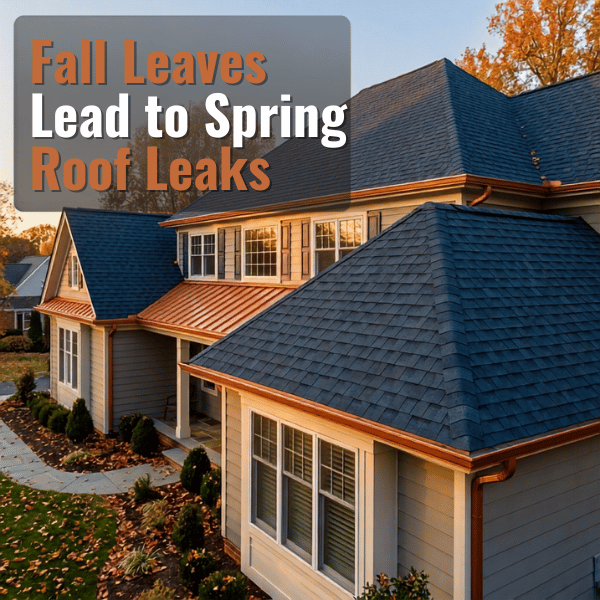
Homeowners often wonder how fallen leaves lead to spring roof leaks after winter ends. Understanding how fallen leaves lead to spring roof leaks helps you protect your home against severe structural damage.
Autumn brings colorful foliage across Virginia residential properties. However, falling leaves create serious long-term risks for asphalt shingle roofs. Oak, maple, and pine trees shed organic matter every autumn. Heavy debris settles inside roof valleys, behind chimneys, and along gutters. According to industry research on roof debris from GAF, trapped organic matter traps moisture directly against roofing materials. Damp leaves create a continuous wet sponge on top of your shingles. This standing water accelerates asphalt breakdown long before spring rains arrive.
Many homeowners ignore autumn foliage until warm weather returns. Unfortunately, hidden destruction occurs throughout the dark winter months. Moisture trapped under foliage undergoes repeating freeze-thaw cycles. Water expands when it freezes into solid ice. This physical expansion forces shingle edges upward and breaks surrounding seals. When heavy spring downpours hit, rainwater enters those open gaps easily. Upgrading to a comprehensive residential roof replacement stops chronic structural failure before internal drywall stains form on your ceilings.
How Fallen Leaves Lead to Spring Roof Leaks Through Capillary Action
Liquid water behaves according to precise physical laws on a sloped roof surface. Capillary action is one primary driver of hidden moisture intrusion. Capillary action occurs when water moves through narrow spaces without the assistance of gravity. Tight gaps between overlapping asphalt shingles create natural narrow channels. Wet leaf piles seal those tight gaps and trap liquid against the shingle surface.
Damp leaves prevent solar heat from drying asphalt materials naturally. Normal runoff paths become blocked by packed organic foliage mats. Surface tension draws trapped water backward under asphalt shingle edges. Water travels upward beneath the exposed shingle surface. It reaches unprotected nail penetrations and wooden decking beneath the underlayment.
Over time, constant moisture rots the wooden deck boards under your roofing layers. Rotted decking loses structural integrity quickly. Soft wood cannot hold roofing nails securely in place over time. Loose nails lift higher during heavy winter winds. This mechanical failure allows driving rain to enter directly during spring storms.
How Fallen Leaves Lead to Spring Roof Leaks via Hydrostatic Pressure
Hydrostatic pressure measures the downward force exerted by standing fluid at rest. Heavy piles of wet leaves create high hydrostatic pressure on asphalt shingles. Standard asphalt shingles shed gravity-driven water effectively. However, shingles do not withstand standing water under continuous pressure.
Dense leaf debris blocks water flow down steep roof slopes. Water pools behind these organic dams during heavy rainstorms. Standing pools generate continuous downward and lateral water pressure against shingle seams. This force pushes liquid past overlapping shingle seams and underlayment layers.
Winter weather worsens hydrostatic pressure behind leaf dams on your roof. Trapped water freezes solid during cold Virginia nights. Ice expands by roughly nine percent in total volume as it solidifies. This expanding ice pushes flashing away from wall intersections, dormers, and chimneys.
When spring temperatures rise, winter ice thaws rapidly into liquid water. Melted water encounters damaged metal flashing and lifted shingle tabs. High hydrostatic pressure forces water straight into your attic space. Damp attic insulation then loses thermal performance and breeds toxic mold growth.
Homeowners can review options on our why us page to see how robust installation standards prevent moisture penetration. Investing in quality materials provides long-term protection against seasonal hydrostatic failure.
How Fallen Leaves Lead to Spring Roof Leaks in Virginia Homes
Virginia weather creates ideal conditions for organic decay and roof leaks. Heavy autumn canopy cover is common throughout Spotsylvania County. Pine needles, oak leaves, and small twigs collect densely in vulnerable roof valleys.
High humidity levels in Virginia delay natural evaporation throughout the fall. Wet leaf mats remain damp for weeks during late autumn. Acidic compounds leach out of decaying organic vegetation continuously. These natural acids break down protective asphalt granules over time. Granules protect raw asphalt coatings against harmful ultraviolet sun rays.
Without protective granules, exposed asphalt dries out and cracks. UV radiation accelerates thermal degradation on bare shingle surfaces. Cracks extend through the entire shingle body over several months.
Winter in Stafford County introduces repeated freezing and thawing cycles. Melted snow cannot drain properly past leaf-clogged gutters. Ice dams form quickly along cold eave edges during freezing spells. Trapped meltwater backs up beneath the lower shingle courses.
Spring brings heavy rainstorms and sudden temperature shifts across the region. Weakened shingles fail completely under sudden water volume. Water flows past degraded underlayment directly into ceiling joists and living spaces.
Preventing Moisture Damage with Proper Drainage Solutions
Clearing roof debris is vital for long-term structural home health. Clogged gutters represent the most common cause of foliage backup. When gutters fill with leaves, rainwater overflows near exterior walls. Overflowing water rots wooden fascia boards and rafter tails quickly.
Installing high-quality gutters and gutter guards keeps drainage paths clear year-round. Modern leaf guards prevent pine needles and leaves from blocking water flow. Clear gutters direct heavy rainfall safely away from foundation walls.
Aging roof systems struggle to handle extreme foliage buildup. Old shingles lose flexibility and crack easily under organic loads. Replacing an aged roof eliminates hidden deck rot and persistent spring leaks.
Homeowners can explore flexible financing options to manage roof replacement costs comfortably. Modern monthly payment plans fit smoothly into standard household budgets.
Final Takeaway on Leaf Debris and Roof Protection
Understanding how fallen leaves lead to spring roof leaks protects your major property investment. Fallen debris traps standing moisture and creates destructive capillary action. Hydrostatic pressure drives water past lifted shingle edges during winter thaws. Acidic vegetation breaks down granule coatings and exposes raw asphalt material to UV rays. Addressing leaf accumulation prevents costly interior water stains and attic structural rot.
Do not wait for active spring ceiling leaks to compromise your home stability. Schedule Your Roof Replacement Consultation with our experienced team today to secure complete long-term roof protection.