
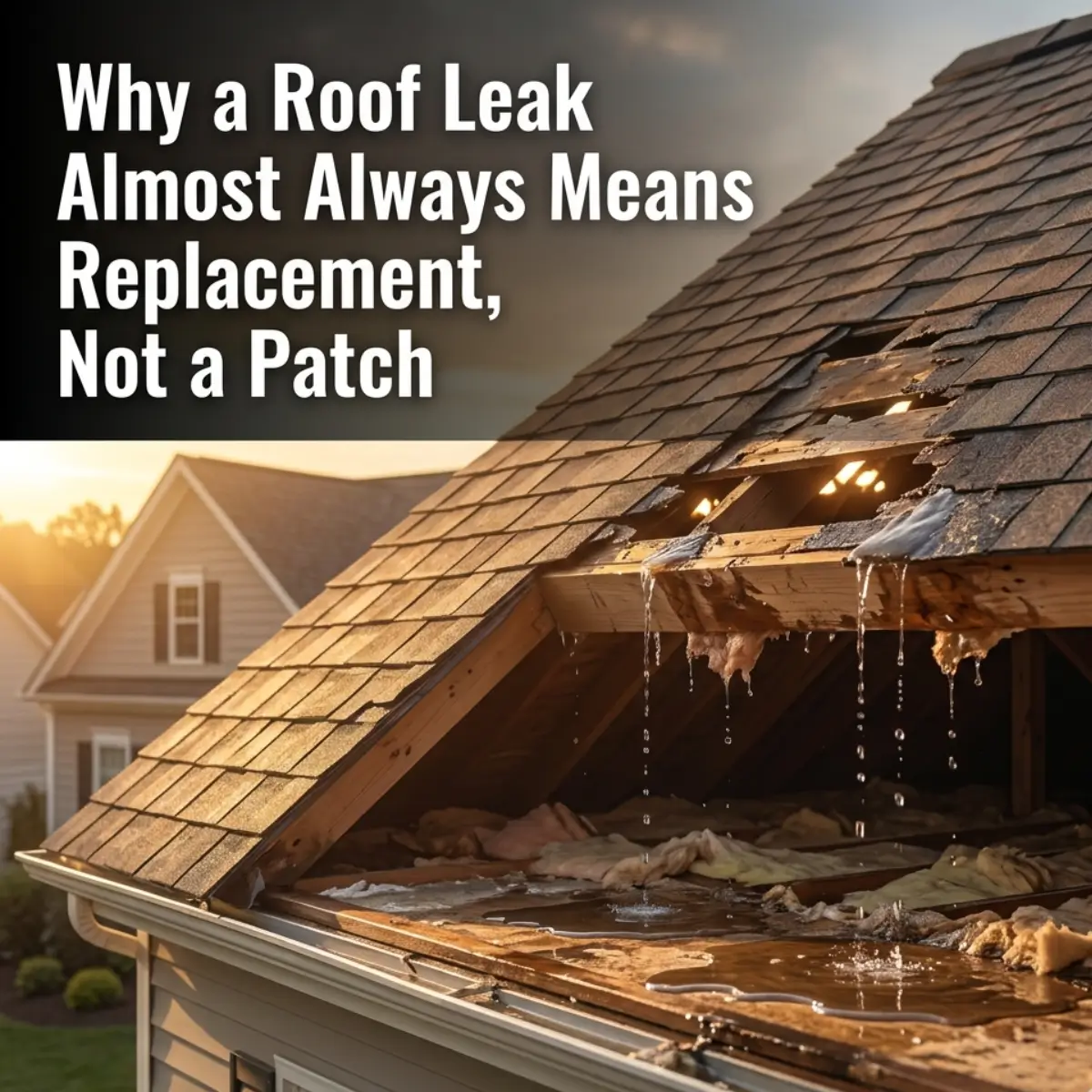
A roof leak is rarely a single point of failure. A real roof leak repair Caroline County VA project starts with a hard truth: the spot where water shows up on the ceiling is almost never the spot where the roof is failing. By the time water reaches drywall, the roof system has been leaking somewhere for months.
According to CertainTeed, water can travel along rafters, decking, and insulation for ten feet or more before it pools. That distance is why a patch over a stain rarely solves the leak. It only hides the symptom.
The Physics of a Roof Leak
Water moves through a roof in three ways. Gravity pulls it down. Capillary action pulls it sideways through tight gaps. Hydrostatic pressure from wind-driven rain pushes it uphill under shingles. All three forces act on a Virginia roof during every storm.
A small crack in a shingle does not leak on a calm rainy day. The same crack leaks heavily in a windstorm. Wind drives water sideways at high pressure. The water finds the crack. It works its way under the shingle. Capillary action pulls it sideways across the underlayment. The water reaches a nail hole. It drips onto the decking. The decking soaks it up. The leak begins.
By the time the homeowner sees a stain inside, the underlayment has been wet through dozens of storms. The wood deck has lost some of its strength. The framing may already show signs of rot.
Why a Patch Rarely Fixes a Roof Leak Repair Caroline County VA Job
Initially, a patch on a leaky roof works well if the shingles are young. New materials bond easily to their neighbors because the seal strips are still tacky. Under these conditions, a small repair seals up cleanly.
That math changes after year 15. Aged shingles lose their adhesion, meaning new pieces won’t bond well to brittle ones. Because the patch creates a hard line between old and new, water often finds a way through. Essentially, the patch becomes the site of your next leak.
What a Leak Hides Underneath the Shingles
Most leaks reveal more damage than the homeowner expected. Once we tear off the shingles, the real story shows up.
- Soft, dark plywood where water sat and rotted the deck.
- Black mold growing on the underside of the deck and rafters.
- Rusted nails that no longer hold shingles in a high wind.
- Insulation that is matted, wet, and useless.
- Sheathing that flexes underfoot and needs full replacement.
None of this damage is visible from the ground. None of it shows up in a standard walkthrough. It only reveals itself during a tear-off. That is why a tear-off and replacement is the only way to be sure the leak is truly fixed.
Hot Take: A Patch Resets the Clock on Nothing
Most homeowners hope a patch will buy them five more years. The hard truth is that a patch on a 20-year-old roof rarely buys two.
The patch fixes one square foot of a roof system that is 2,500 square feet large. The other 2,499 square feet are just as old. They are just as worn. The next leak is already forming. Within a year or two, the homeowner is back on the phone for another repair. By that point, the cost of repeated patches has eaten into the budget for a real replacement.
The honest move is the harder one. When a roof is past 18 years old and starts leaking, the smart play is to plan the full roof leak repair Caroline County VA project as a replacement. We can help with the budget side too. Our financing options let homeowners spread the cost over manageable monthly payments instead of putting the whole project on a credit card.
Why Virginia Weather Multiplies Roof Leaks
Virginia gets every kind of weather a roof can face. Heavy summer thunderstorms with wind gusts over 50 miles per hour. Hailstorms that bruise shingles without breaking them. Hot, humid summers that bake the asphalt. Freeze-thaw winter cycles that flex every shingle.
Each weather event finds the weakest spot on the roof. Hailstorms knock granules loose. UV degradation breaks down what is left. Wind-driven rain finds the cracks. Snow load tests the deck. Ice dams force water under the shingles at the eave.
Roofs in Caroline County see all of this. So do roofs across the rest of the Fredericksburg region. The climate cuts the working life of a typical asphalt roof to about 20 years instead of the 25 to 30 the manufacturer might suggest.
Golden Nugget: The 1-2-3 Rule on Roof Leaks
Use this simple test the next time you see a stain on the ceiling.
One: How old is the roof? If it is over 18 years old, plan for replacement, not patching. Two: How many leaks have you had? If this is the second leak in two years, the roof is failing as a system. Three: Is the leak in a valley, around a chimney, or near a vent? Those are the spots where flashing fails first. A flashing failure means several other parts of the system are at the end of their service life too.
Two yes answers out of three points to replacement.
What to Look For in a Replacement Contractor
Oftentimes, leaks reveal more damage than a homeowner expects. Once we tear off the shingles, the real story of the roof’s condition shows up:
- Soft, dark plywood where water sat and rotted the deck.
- Black mold growing on the underside of the deck and rafters.
- Rusted nails that no longer hold shingles in a high wind.
- Insulation that is matted, wet, and useless.
- Sheathing that flexes underfoot and needs full replacement.
Since none of this damage is visible from the ground, it rarely shows up in a standard walkthrough. Only a full tear-off reveals these hidden issues, which is why replacement is the most reliable way to ensure the leak is truly fixed.
Takeaway: Stop Patching, Start Planning Your Roof Leak Repair Caroline County VA Project
A roof leak is the roof telling you something. Most of the time, that something is that the system has aged out. Patching a 20-year-old roof is a delay, not a fix. A planned roof leak repair Caroline County VA replacement project rebuilds the system, restores the warranty, and ends the cycle of repeat repair calls. Talk to our team and we will give you a real read on whether your roof needs a patch or a plan. Start at fredxteriors.com/contact.
FAQ’s
A localized repair is possible if the roof is young (under 15 years) and the leak is caused by isolated damage, like a single blown shingle or failing flashing. However, if your roof is older or showing multiple leaks, a patch is often a temporary fix that masks systemic failure.
Minor repairs like replacing a few shingles or resealing a vent pipe usually cost between $300 and $800. If the leak has caused structural damage to the plywood decking or framing, costs increase significantly, which is why a full replacement is often more cost-effective for aging roofs.
Most insurance policies cover roof repairs if the leak was caused by a sudden, accidental event like a windstorm or fallen tree limb. Insurance typically does not cover leaks caused by wear and tear, lack of maintenance, or a roof that has simply reached the end of its service life.